
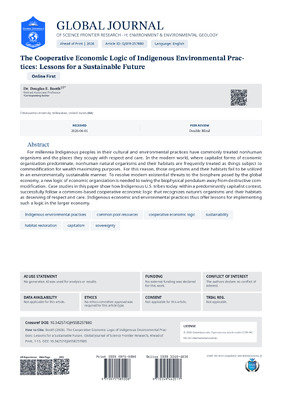
The Cooperative Economic Logic of Indigenous Environmental Practices: Lessons for a Sustainable Future
capitalism, common-pool resources, cooperative economic logic, habitat restoration, Indigenous environmental practices, sovereignty, Sustainability
Abstract
For millennia Indigenous peoples in their cultural and environmental practices have commonly treated nonhuman organisms and the places they occupy with respect and care. In the modern world, where capitalist forms of economic organization predominate, nonhuman natural organisms and their habitats are frequently treated as things subject to commodification for wealth maximizing purposes. For this reason, those organisms and their habitats fail to be utilized in an environmentally sustainable manner. To resolve modern existential threats to the biosphere posed by the global economy, a new logic of economic organization is needed to swing the biophysical pendulum away from destructive commodification. Case studies in this paper show how Indigenous U.S. tribes today, within a predominantly capitalist context, successfully follow a commons-based cooperative economic logic that recognizes nature's organisms and their habitats as deserving of respect and care. Indigenous economic and environmental practices thus offer lessons for implementing such a logic in the larger economy.
Downloads
How to Cite
References
B. Allred, S. Fuhlendorf, R. Hamilton (2011) The role of herbivores in Great Plains conservation: comparative ecology of bison and cattle. 2(3), 1-17.
P. Amoss (1987) The Fish God Gave Us: The First Salmon Ceremony Revived. 24(1), 56-66.
K. Basso (1996) Wisdom Sits in Places: Landscape and Language among the Western Apache.
S. Beckert (2025) Capitalism: A Global History.
B. Berger (2024) Intertribal: The unheralded element in Indigenous wildlife sovereignty. 48, 1-43.
M. Blumm, J. Steadman (2009) Indian Treaty Fishing Rights and Habitat Protection: The Martinez Decision Supplies a Resounding Judicial Reaffiffirmation. 49(3), 653-706.
G. Boldt (1974) The Boldt Decision. https://wdfw.wa.gov/sites/default/files/2021-12/boldt_decision.pdf
A. Booth, H. Jacobs (1990) Ties that bind: Native American beliefs as a foundation for environmental consciousness. 12(2), 27-43.
D. Booth (2026) Bringing back the bison: Environmental values and the ecological restoration of Great Plains shortgrass prairies. 35(1), 46-64.
C. Bowhay (2013) Native Amerian Tribal Treaty Rights and Fisheries Co-management in the U.S. Pacific Northwest. 447-457.
D. Boxberger (1989) To Fish in Common.
S. Breslow (2014) Tribal Science and Farmers' Resistance: A Political Ecology of Salmon Habitat Restoration in the American Northwest. 87(3), 695-726.
L. Bryan (1991) The Buffalo People: Prehistoric Archaeology on the Canadian Plains.
E. Callenbach (1996) Bring Back the Buffalo! A Sustainable Future for America's Great Plains.
J. Callicott (1982) Traditional American Indian and Western European attitudes toward nature: an overview. 4(4), 293-318.
S. Campbell, V. Butler (2010) Archaeological Evidence for Resilience of Pacific Northwest Salmon Populations and the Socioecological System over the last ~7,500 years. 15(1).
C. Cason (2023) Case Comment: Sauk-Suiattle Indian Tribe On Its Own Behalf And In Its Capacity As Sahkuméhu Ex Rel Tsuladxw V. City of Seattle.
J. Chamberlin, O. Stefankiv, E. Beamer, C. Greene, W. Hood, S. Munsch (2025) Estimating estuary habitat change and functional trajectory of restoration projects over two decades in Puget Sound, WA. 12, 1549344.
J. Collins (1952) The Mythological Basis for Attitudes toward Animals among Salish-Speaking Indians. 65(258), 353-359.
V. Cordova (2007) How It Is: The Native American Philosophy of V. F. Cordova.
S. Cornell, J. Kalt (2000) Where's the glue? Institutional and cultural foundations of American Indian economic development. 29(5), 443-470.
W. Cronon (1991) Nature's Metropolis: Chicago and the Great West.
CROPP Cooperative (2013) Crop Cooperative Roots: The First 25 Years.
J. Crutchfield, G. Potecorvo (1969) The Pacific Salmon Fisheries: A Study of Irrational Conservation.
T. Davis (2000) Sustaining the Forest, the People, and the Spirit.
V. Deloria (2012) The Metaphysics of Modern Existence.
G. Dow (2018) The theory of the labor‐managed firm: Past, present, and future. 89(1), 65-86.
M. Ebert (2010) Human Versus Person: An Examinaton of Nature/Culture on the Northwest Coast. 19(1), 29-50.
M. Egli (2019) Negotiating Stronghold Table: Figuring the Badlands in National and Local News.
H. Epp, I. Dyck (2002) Early human-bison population interdependence in the Plains ecosystem. 12(2), 323-337.
K. Goodpaster (1978) On Being Morally Considerable. 75(6), 308-325.
D. Graeber, D. Wengrow (2021) The Dawn of Everything: A New History of Humanity.
E. Gunther (1926) An Analysis of the First Salmon Ceremony. 28(4), 605-617.
A. Guttmann (2021) commons and cooperatives: a new governance of collective action. 92(1), 33-53.
A. Harmon (1998) Indians in the Making.
A. Isenberg (2000) The Destruction of the Bison: An Environmental History, 1750-1920.
R. Jackson, C. Gratton (2026) Grassland 2.0-agroecosystem that care for us today while building capacity for future generations to do the same. 9, 1696429.
T. Jackson (2026) The Insatiable Machine: How Capitalism Conquered the World.
B. Jossa (2014) Producer Cooperatives as a New Mode of Production.
S. Langdon (2007) Sustaining a Relationship: Inquiry into the Emergence of a Logic of Engagement with Salmon among the Southern Tlingits.
W. Lazonick, M. O'Sullivan (2000) Maximizing Shareholder Value: A New Ideology for Corporate Governance. 29(1), 13-35.
D. Lepofsky, M. Caldwell (2013) Indigenous marine resource management on the Northwest Coast of North America. 2, 12.
S. Lewis, M. Maslin (2018) The Human Planet: How We Created the Anthropocene.
J. Madson (1995) Where the Sky Began: Land of the Tallgrass Prairie.
A. Malm (2013) The Origins of Fossil Capital: From Water to Steam in the British Cotton Industry. 21.1.
K. Marx (1990) Capital: A Critique of Political Economy (Vol. 1).
K. Mauer (2021) Unsettling Resilience: Colonial Ecological Violence, Indigenous Futurisms, and the Restoration of the Elwha River. 86(3), 611-634.
D. Mausel, T. Waupochick, M. Pecore (2017) Menominee Forestry: Past, Present, Future. 115(5), 366-369.
J. Moore (2000) Environmental crises and the metabolic rift in world-historical perspective. 13(2), 123-157.
NOAA Fisheries (2024) The Elwha River Restoration: A Case Study in Adaptive Management for Salmon Recovery. https://www.fisheries.noaa.gov/feature-story/elwha-river-restoration-case-study-adaptive-management-salmon-recovery
Northwest Indian Fisheries Commission (2016) 2016 State of Our Watersheds: A Report by the Treaty Tribes in Western Washington.
Northwest Indian Fisheries Commission (2020) 2020 State of Our Watersheds: A Report by the Treaty Tribes in Western Washington.
Organic Valley (2020) Organic Valley Exceeds $1.1 Billion in Sales for Fourth Consecutive Year. https://www.organicvalley.coop/newspress/organic-valley-exceeds-11-billion-sales-fourth-consecutive-year
Organic Valley (2025) 441,000 Acres and Counting. How Many Organic Valley Acres in Your State?. https://www.organicvalley.coop/blog/organic-acres-by-state
E. Ostrom (1990) Governing the Commons: The Evolution of Institutions for Collective Action.
D. Parman (1984) Inconstant Advocacy: The Erosion of Indian Fishing Rights in the Pacific Northwest, 1933-1956. 53(2), 163-189.
S. Piccolo (2024) Critical theory and North American indigenous thought. 23(4), 545-566.
D. Posthumus (2016) A lakota view of Pté Oyáte (Buffalo nation). 278-310.
H. Rolston (1986) Philosophy Gone Wild.
H. Shamon, O. Crosby, C. Andersen, H. Augare, J. Stiffarm, C. Bresnan, T. Akre (2022) The potential of bison restoration as an ecological approach to future tribal food sovereignty on the Northern Great Plains. 10, 1-15.
K. Sherman, J. Van Lanen, R. Sherman (2010) Practical environmentalism on the Pine Ridge Reservation: Confronting structural constraints to Indigenous stewardship. 38(4), 507-520.
K. Surma (2023) Lawsuit Asserting the 'Rights of Salmon' Ends in a Settlement That Benefits The Fish. https://insideclimatenews.org/news/06052023/lawsuit-asserting-the-rights-of-salmon-ends-in-a-settlement-that-benefits-the-fish/#:~:text=A%20landmark%20lawsuit%20filed%20by,dams%20on%20the%20Skagit%20River
J. Taylor (1999) Making Salmon: An environmental history of the Northwest fisheries crisis.
H. Thomas, C. Logan (1982) Mondragon: An Economic Analysis.
T. Thornton, D. Deur, H. Kitka (2015) Cultivation of Salmon and other Marine Resourceson the Northwest Coast of North America. 43, 189-199.
R. Trosper (2002) Northwest Coast Indigenous Institutions that Supported Resilence and Sustainability. 41, 329-344.
R. Trosper (2007) Indigenous influence on forest management on the Menominee Indian Reservation. 249(1-2), 134-139.
D. Undersander, S. Temple, J. Bartlet, D. Sample, L. Paine (2020) Grassland birds: Fostering habitats using rotational grazing.
B. Upton (2015) Returning to a Tribal Self-Governance Partnership at the National Bison Range Complex: Historical, Legal, and Global Perspectives. 35, 53-145.
D. Waller, N. Reo (2018) First stewards: ecological outcomes of forest and wildlife stewardship by Indigenous peoples of Wisconsin, USA. 23(1), 45.
R. Waples, G. Pess, T. Beechie (2008) Evolutionary history of Pacific salmon in dynamic environments. 1(2), 189-206.
C. Webb (2025) The Arrogant Ape: The Myth of Human Excptionalism and Why it Matters.
A. Weber (2016) The Biology of Wonder: Aliveness, Feeling, And Metamorphosis of Science.
A. Weber, F. Varela (2002) Life after Kant: Natural purposes and the autopoietic foundations of biological individuality. 1(2), 97-125.
L. White (1967) The Historical Roots of Our Ecological Crisis. 155, 1203-1207.
P. White (2024) Co-stewardship in practice: Yellowstone bison. 47, 128-159.
C. Wilkinson (2005) Blood Struggle:The Rise of Modern Indian Nations.
C. Wilkinson (2024) Treaty Justice: The Northwest Tribes, the Boldt Decision, and the Recognition of Fishing Rights.
T. Yifat (2016) Organic Valley: Agent of Civil Society in the Market.
Published
2026-09-28
Issue
Section
License
Copyright (c) 2026 Authors and Global Journals Private Limited

This work is licensed under a Creative Commons Attribution 4.0 International License.