
Water Quality Evaluation of Hand-Dug Wells in Ibadan, Oyo State, Nigeria
hand dug well, groundwater, protected well, semi-protected well, un-protected well, Groundwater, Hand dug well
Abstract
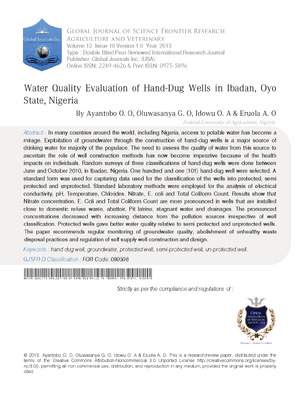
In many countries around the world, including Nigeria, access to potable water has become a mirage. Exploitation of groundwater through the construction of hand-dug wells is a major source of drinking water for majority of the populace. The need to assess the quality of water from this source to ascertain the role of well construction methods has now become imperative because of the health impacts on individuals. Random surveys of three classifications of hand-dug wells were done between June and October 2010, in Ibadan, Nigeria. One hundred and one (101) hand-dug well were selected. A standard form was used for capturing data used for the classification of the wells into protected, semi protected and unprotected. Standard laboratory methods were employed for the analysis of electrical conductivity, pH, Temperature, Chlorides, Nitrate, E. coli and Total Coliform Count. Results show that Nitrate concentration, E. Coli and Total Coliform Count are more pronounced in wells that are installed close to domestic refuse waste, abattoir, Pit latrine, stagnant water and drainages. The pronounced concentrations decreased with increasing distance from the pollution sources irrespective of well
Downloads
How to Cite
References
O. Adeyemi, O. Oloyede, A. Oladiji (2007) Physicochemical and microbial characteristics of leachate-contaminated groundwater.
(2000) World Water Vision: Making Water Everybody's Business. 108.
(2002) Community participation in water and sanitation. 27.
Denby Lloyd, Jeffrey Koenings, Jacqueline LaPerriere (1987) Effects of Turbidity in Fresh Waters of Alaska. 7(1), 18-33. https://doi.org/10.1577/1548-8659(1987)7
S. Murcott (2007) Water sources (improved and un-improved) and water supply ,MIT 11. 79. https://doi.org/10.1002/wer.2007.79.issue-11
National Bureau of Statistics (2006) Nigeria provisional results for 2006 population census.
Oluwasanya (2009) Better Safe than Sorry: Towards Appropriate Water Safety Plans for Urban Self Supply Systems in developing countries, Phd. 459.
Grace Oluwasanya, Jennifer Smith, Richard Carter (2011) Self supply systems: Urban dug wells in Abeokuta, Nigeria. 11(2), 172-178. https://doi.org/10.2166/ws.2011.026
C. Seamus (2000) Hand dug shallow wells, principles of Hand dug wells. 5, 29-33.
T. Shimizu, H. Agatomo, T. Kigotake (1980) Bacteria contamination of drinking water from wells in Miyazaki, Miyazaki University. 21-28.
UNICEF (2005) National Rural water supply and Sanitation investment program. 1.
Simon Watt, W. Wood (1977) Prelims - Hand Dug Wells and their Construction. i-12. https://doi.org/10.3362/9781780445083.000
WHO (2004) Guidelines for drinking-water Quality. 2.
WHO (2006) Water quality for drinking: who guidelines.
WHO (2011) Guidelines for drinking-water quality, World Health Organization, Geneva.
Published
2013-08-12
Issue
Section
License
Copyright (c) 2013 Authors and Global Journals Private Limited

This work is licensed under a Creative Commons Attribution 4.0 International License.