Coefficient Problem for Certain Subclass of Analytic Functions Using Quasi-Subordination

Authors

  • B. Srutha Keerthi

  • S. Prema

coefficient functional for functions belonging

Abstract

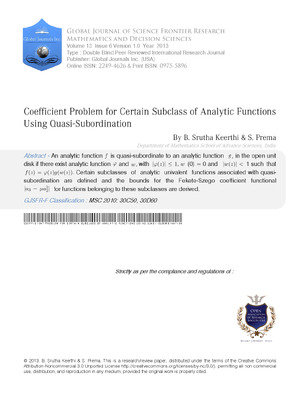
An analytic function is quasi-subordinate to an analytic function , in the open unit disk if there exist analytic function and , with (0) = 0 and 1 such that Certain subclasses of analytic univalent functions associated with quasisubordination are defined and the bounds for the Fekete-Szego coefficient functional for functions belonging to these subclasses are derived.

Downloads

How to Cite

Coefficient Problem for Certain Subclass of Analytic Functions Using Quasi-Subordination. (2013). Global Journal of Science Frontier Research, 13(26), 47-53. https://journalofscience.org/index.php/GJSFR/article/view/

Author Biographies

B. Srutha Keerthi

Dr. B. Srutha Keerthi is an accomplished mathematician and academic currently serving as an Assistant Professor in the School of Advanced Sciences, Department of Mathematics at V.I.T University (Chennai Campus), India. With a career spanning over two decades, she has held faculty positions at several prestigious institutions including Sri Venkateswara College of Engineering, Vel-Tech College of Engineering, Hindusthan College of Arts and Science, and Adhiyamaan College of Engineering. Dr. Keerthi earned her Ph.D. in Mathematics from Madras Christian College in 2010, following an M.Phil and M.Sc. from Pondicherry University. Her research focuses on complex analysis, particularly analytic univalent functions, Sakaguchi type functions, and coefficient estimates using quasi-subordination. She has published 35 scholarly works, accumulating over 106 citations, with an h-index of 6 and an i10-index of 5. Dr. Keerthi has also been awarded a research grant from the Department of Science and Technology, Ministry of Science and Technology, India, for her work on classes of analytic univalent functions. Her contributions to the field are reflected in her active membership in the academic community and her ongoing research in geometric function theory.

S. Prema

S. Prema is a mathematician based in Chennai, Tamil Nadu, India, with a focus on complex analysis and geometric function theory. Her research interests include the study of analytic functions, coefficient problems, and quasi-subordination. She has contributed to the field with her work on coefficient estimates for certain subclasses of analytic functions. Affiliated with the Mathematics department (H&S) in Agarmel, Poonamallee, Chennai, she continues to explore advanced topics in mathematical analysis. Her work has been published in peer-reviewed journals, reflecting her dedication to advancing the understanding of analytic function theory.

References

Subordination P. Duren, in Analysis, Springer Lecture Notes in Mathematics, Germany Berlin (1977) Subordination. 599, 22-29.

W. Ma, D. Minda (1994) A unified treatment of some special classes of univalent functions. 1, 157-169.

M. Robertson (1970) Quasi-subordination and coefficient conjectures. 76(1), 1-9. https://doi.org/10.1090/s0002-9904-1970-12356-4

O. Altinta¸s, Majorizations S. Owa, quasi-subordinations functions, Proceedings AcademyA (1992) Majorizations and quasi-subordinations for certain analytic functions. 68(7), 181-185.

S. Lee Quasi-subordinate functions and coefficient conjectures. (1), 43-50.

F. Ren, S. Owa, S. Fukui, Some functions, Bulletin of the Australian Mathematical Society (1991) Some inequalities on quasi-subordinate functions. 43(2), 317-324.

S. Miller, P. Mocanu, M. Reade (1972) Revue Roumaine Mathematiques Pures Appliquees. 17, 1395-1397.

Z. Lewandowski, S. Miller, E. Zlotkiewicz (1976) Gamma-starlike functions. 28, 53-58.

M. Darus, D. Thomas (1998) Convex Functions. 29(10), 1049-1059.
Coefficient Problem for Certain Subclass of Analytic functions using Quasi-Subordination

Published

2013-06-05

How to Cite

Coefficient Problem for Certain Subclass of Analytic Functions Using Quasi-Subordination. (2013). Global Journal of Science Frontier Research, 13(26), 47-53. https://journalofscience.org/index.php/GJSFR/article/view/