
The Fundamental Forces and Their Unification
matter, mass and energy, energy limit, energy sharing, excess-energy releasing, unity
Abstract
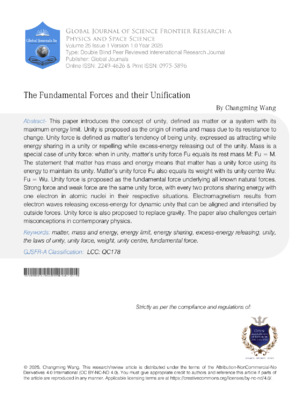
This paper introduces the concept of unity, defined as matter or a system with its maximum energy limit. Unity is proposed as the origin of inertia and mass due to its resistance to change. Unity force is defined as matter's tendency of being unity, expressed as attracting while energy sharing in a unity or repelling while excess-energy releasing out of the unity. Mass is a special case of unity force: when in unity, matter's unity force Fu equals its rest mass M: Fu = M. The statement that matter has mass and energy means that matter has a unity force using its energy to maintain its unity. Matter's unity force Fu also equals its weight with its unity centre Wu: Fu = Wu. Unity force is proposed as the fundamental force underlying all known natural forces. Strong force and weak force are the same unity force, with every two protons sharing energy with one electron in atomic nuclei in their respective situations. Electromagnetism results from electron waves releasing excess-energy for dynamic unity that can be aligned and intensified by outside forces. Unity force is also proposed to replace gravity. The paper also challenges certain misconceptions in contemporary physics.
Downloads
How to Cite
References
The Britannica (2024) Fundamental force. https://www.britannica.com/science/fundamental-interaction
Christine Sutton (2025) A theory of everything. https://www.britannica.com/science/subatomic-particle/A-theory-of-everything
The Britannica (2024) General relativity. https://www.britannica.com/science/general-relativity
Gordon Squires (2024) Encyclopedia. https://www.britannica.com/science/quantum
Christine Sutton (2025) Encyclopedia. https://www.britannica.com/science/standard-model
Changming Wang (2025) The Principles of Matter. 24(A5), 55-57. https://doi.org/10.34257/gjsfravol24is5pg55
Changming Wang (2025) The Nature of Photons. 24(A5), 49-50. https://doi.org/10.34257/gjsfravol24is5pg49
Christine Sutton (2024) Encyclopedia. https://www.britannica.com/science/strong-force
The Britannica (2024) Encyclopedia. https://www.britannica.com/science/big-bang-model
The Britannica (2021) Proton-proton chain. https://www.britannica.com/science/proton-proton-cycle
The Britannica (2024) Encyclopedia. https://www.britannica.com/science/carbon-14
Wikipedia (2024) Beta decay. https://en.wikipedia.org/wiki/Beta_decay
Edwin Kashy, ;. Sharon, Bertsch McGrayne (2025) Encyclopedia. https://www.britannica.com/science/electromagnetism
The Britannica (2024) Newton's law of gravitation. https://www.britannica.com/science/Newtons-law-of-gravitation
Published
2025-01-15
Issue
Section
License
Copyright (c) 2025 Authors and Global Journals Private Limited

This work is licensed under a Creative Commons Attribution 4.0 International License.